End-of-life for THAT arrays
2026-10-01 news electronics MSK 013
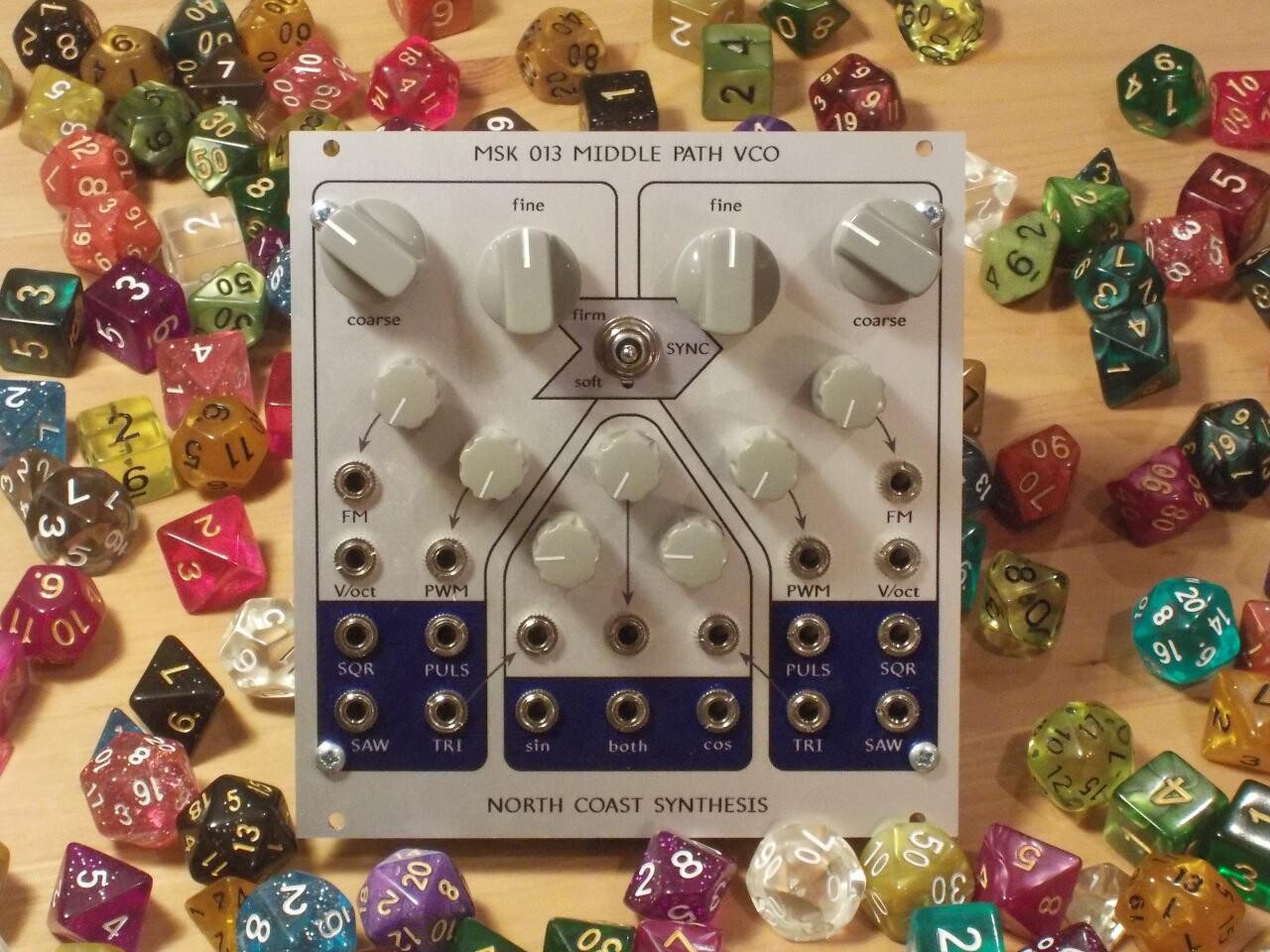
THAT Corporation, makers of analog audio chips, last month announced "end of life" for some of their best-known products, including the THAT320 transistor arrays that are critical components in the MSK 013 Middle Path VCO. I still have both assembled and kit versions of the Middle Path module in stock, and enough chips to maybe do one more production run, but there is no easy way to substitute for the THAT320 chip, and my expectation is to discontinue the module once my supplies run out.
Here's a link to the chip manufacturer's announcement (PDF file) and a local copy in case the copy on their site becomes inaccessible.
What's special about the THAT320?
The THAT320 is a dielectrically isolated array of four discrete PNP transistors. That means it's four transistors that are all built into the same crystal of silicon, but insulated from each other, each in its own separate "tub" of silicon dioxide.
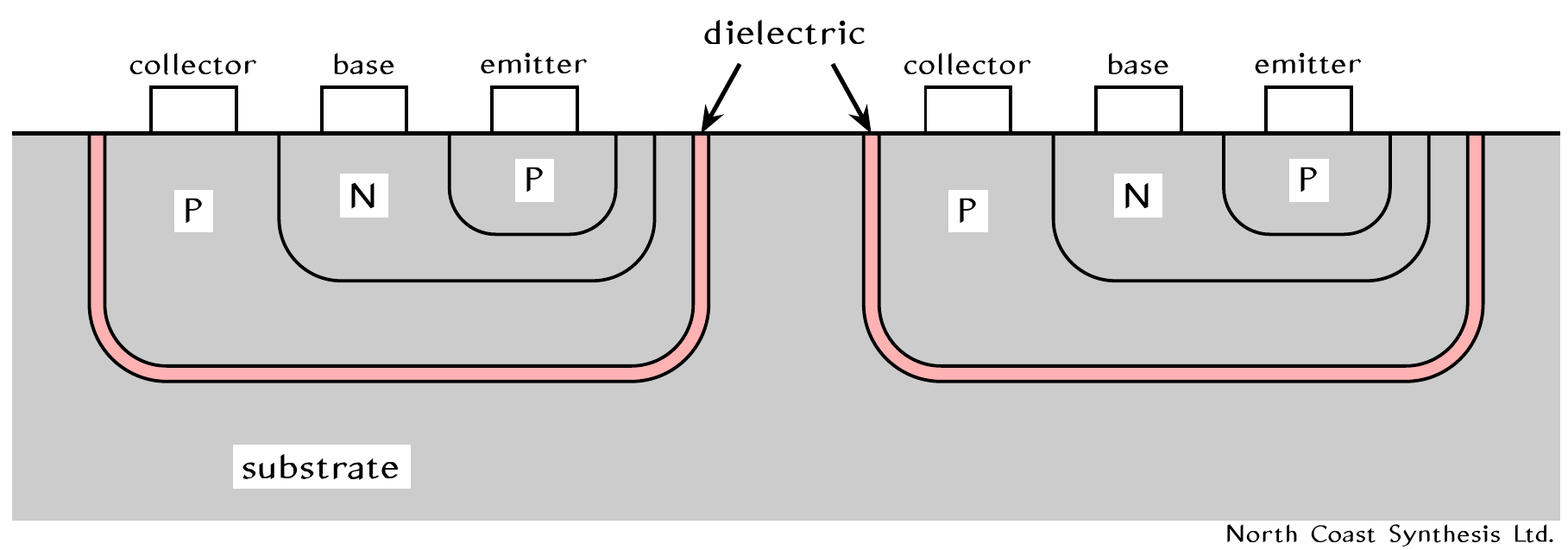
The point of having something like that, is that it's a way to have several transistors that are electrically independent of each other but thermally coupled. They will all stay at the same temperature. Crystalline silicon happens to be an excellent conductor of heat, and having the transistors all on the same crystal also means they are physically close to each other, so there's very little distance for the heat to travel. Both effects mean that any temperature fluctuations should affect all the transistors on the chip equally, even as the transistors themselves produce varying amounts of heat. And keeping them at the same temperature is an important part of the larger effort to keep the transistors' properties matched, which is necessary for accurate performance in many analog applications.
In the Middle Path in particular, it's used in the exponential converter. By having four transistors on the same chip, I can use two of them for measuring transistor properties at two different current levels, and then one more actually does the exponential conversion for each of the two oscillators. I use analog-multiplier chips to fit a voltage-to-current curve to the measured performance of the transistors before applying it to the control input, and that makes for a stable and little-trimming-required dual voltage-to-frequency converter. Without the THAT320 chip or something a lot like it, keeping the two oscillators in the module in tune (both in absolute terms, and relative to each other) would be a lot harder.
The THAT320 data sheet includes some ad copy about how their chip has specially selected, matched transistors on it, and dielectric isolation is better than the reverse-biased junction isolation used in competing products, but that's actually optimistic: at the moment there basically are no competing monolithic matched-transistor products anymore. Dielectric might indeed be better than junction, but you can't have either of them.
You can get multi-transistor packages like the MPQ3904, but they are not monolithic, with all the transistors on the same chip; instead it's four discrete transistor chips mounted in the same package, so you don't really get the high thermal conductivity. There are also some chips called "transistor arrays" that are possibly monolithic, but not actually amplifier transistors, not matched, and have built-in wiring (usually as switches to a common ground) that basically makes it impossible to use them in the applications where you typically want temperature-matched transistors.
Why are they taking it out of production?
Semiconductors need to be made in specialized factories called "fabs" (for "fabrication facilities") and each fab is heavily customized to a specific process. The process means the exact sequence of steps in making the wafers: things like exposing the wafers to different gases, particle beams, and washing procedures. There are many steps in a process to add and remove layers of materials to the chip and get them shaped into the right forms. The process also includes constraints like the size of the wafers and the scale of the features that can be formed on the chip. Once you have a process and a fab for it, you can build different chip designs in that same process by using different masks; but you can't change the process itself. If you want a different process, you have to build a new fab.
A given chip will also be designed for a specific process. If you don't have a fab for the process your chip requires, then you just can't make that chip. At best, maybe you can try to invent a new design, for a new chip that you hope will be equivalent, and design that for the process of a new fab. You can try just shrinking down the masks, to work on a finer-scale process (there is basically a one-way historical march toward smaller and smaller transistor scales, so it's always a matter of shrinking the design), but just shrinking the masks doesn't always work, and it's especially a problem in analog, which is more sensitive to the physical properties of the semiconductor process. Adapting a chip design to a new process is a major development operation and basically the same work as developing a new chip.
It's also a problem if the chip was designed around a special feature of the process, like dielectric isolation, or JFETs. You just may not have a more recent fab, for a more recent process, that is capable of building anything equivalent to the old chips.
That's one of the issues for the THAT transistor arrays in particular. They're built with a process that contains special steps for forming those insulation tubs. Dielectric isolation is an unusual process feature that isn't needed by very many chips, and is especially unnecessary for digital chips. (Except some kinds of flash memory, but those require their own special processes that are unusual in other ways.) A new process just won't include the ability to build insulation tubs suitable for transistor arrays unless it's specifically designed around having that capability, at significant expense; so unless there's solid demand for an analog dielectric isolation process, there won't be any new fabs built to do that.
And then there are more general business considerations. If a chip doesn't sell many units anymore, then how much sense does it make to spend a lot of money on keeping it in production? You'll only lose money, and people do not run businesses for that purpose. The business problem isn't just around building new fabs, but also around keeping existing fabs. Doing that costs money on an ongoing basis, which eventually ceases to make sense.
Earlier discontinuations
We've seen this kind of issue come up time and time again in the synthesizer world. It's a fact of life that analog electronics isn't very popular anymore, and another fact that many analog chips were designed for old processes that are no longer desirable for new designs. The fabs for those processes were kept open as long as the chips made in them were selling, but sales inevitably decreased over time, and costs kept going up, and eventually the fabs were shut down and the chips stopped being available.
That's what happened with all the old CAxxxx chips, which were originally from RCA, then sold (with the fab for them) to Intersil, and eventually discontinued. People moved on from CA-series chips to other, more recent designs with similar functions, and so the originals stopped selling, except for just a few that had no credible replacements. The CA3280, a high-quality OTA, was one of the last CA-series chips to remain at all popular, and its discontinuation was finally announced in 2005, as described in Don Tillman's Web log.
The unique fab for Intersil CA-series chips was actually already shut down well before 2005. For years, they were packaging and selling chips cut from old wafers they still had in stock. When the stock of those ran out, they didn't really have any choice. They couldn't bring back the old fab that had been scrapped. Nobody was going to build a new fab just for a chip that nobody except a few old hobbyists still wanted. THAT Corporation actually ended up inheriting some of the business that was going to Intersil at that point, never mind that I don't think they even had direct replacements for the most-wanted CA-series chips.
Some old audio-relevant analog designs are being kept alive now by Alfa Rpar, in Latvia. The story there is basically that after the breakup of the Soviet Union, some of the old military semiconductor fabs fell into the hands of private enterprise, and are being kept alive more or less to supply the hobbyist market. The military fabs were already long obsolete at that point, but the economics of military production are different: if a superpower has a nuclear missile stockpile that depends on old components, they darn well keep the factories for those components running for as long as they want to have replacement parts, never mind that neither the Soviet military nor any serious commercial player would design those parts into anything new. Then when the world changes, we in the hobbyist world have a gift from the past, in the form of a long-obsolete factory that is still in operational condition and can be turned to peaceful purposes.
Alfa have developed analog audio chips of their own, new designs for the old fab and its process, to replace some that have been discontinued by US-based manufacturers. I don't know all of the relevant business considerations that make Alfa's operation possible. I hope they will live a long time. But it's inevitable that some day, their fab will shut down too. I use Alfa parts in the MSK 015 Quad VCA. They don't make anything that can directly replace the THAT320 in the Middle Path - Alfa's transistor arrays all seem to be NPN, and (although this is less important) lower-performance than THAT's.
For several years, Texas Instruments has been trying to get us all to switch from the popular TL074 op amp to a new and different design that they call the "TL074H." They try to bill it as both actually the same chip (clearly false), and better than the original (true on some specs, false on others). The critical difference is that the TL074H has MOSFET inputs, whereas the TL074 has JFET inputs.
That's really the key to what's going on with the TL074. Because the TL074H has MOSFET inputs, it can be built in different fabs, with a more recent process that is optimized to make MOSFETs. The original TL074 is built in old fabs, with an old process that makes JFETs. Nobody is really interested in developing new processes and building fabs to make analog JFETs anymore. (They're rapidly becoming unobtainable as discrete components, too, bearing in mind that a discrete transistor is really just an IC that happens to have a single transistor on it.) And Texas Instruments in particular doesn't want to keep its old fabs for the JFET process in operation. So, they'd really like to convince customers to switch to MOSFET-input op amps. And some day, the switch to the -H part will be forced on us, whenever the sales of original TL074s fall low enough to no longer justify keeping open whichever is the last fab that can make them. That may, in fact, have already happened - in at least some versions, they have already declared that parts labelled TL074 will actually be TL074H chips inside the package, at TI's discretion. They have quite probably stopped making TL074 wafers except for the military versions, and are doing the "package up old stock" thing now.
About THAT
With the case of THAT Corporation and their transistor arrays in particular, it's kind of a perfect storm. They are a small company with a small market. They have another business (in fabless designs, which they get manufactured in other, more modern fabs that they don't own), so they can shut down their own fab without completely shuttering the company. The chips that they make themselves are something for which they are well known, but are (as they say in the discontinuation letter) only a small fraction of their business, and are getting less and less popular over time. THAT's fab is a fab for an oddball, analog dielectric-isolation process, which is not useful for any recent modern chips, only for keeping alive a few old products. It's not going to become more commercially relevant in the future. It is a 4-inch fab, meaning it makes wafers that are four inches in diameter - a very small wafer size, which means only a few chips per wafer, which means all the per-wafer costs are disproportionately expensive in per-chip terms. And analog is dying in general.
Furthermore, without wanting to get political here, the THAT dielectric-isolation analog fab is located in the USA, specifically Milpitas, California. It's one of the last fabs to actually be located in the USA at all, let alone Silicon Valley in particular. Current US policy makes it very difficult to keep a fab running. Even to the extent there are efforts in place to encourage new semiconductor manufacturing in the USA, and even to the extent those efforts could be successful in getting new fabs built, everybody's policy focus is now on cutting-edge digital MOSFET processes, thought to be useful for building AI computers.
The cutting-edge digital fabs are of no use at all for building analog transistor arrays. It's like saying you're going to build a steel mill, and it will somehow help you process the ore from your uranium mine. Totally different facilities, even if both are called "fabs." Nobody today, nor plausibly in the future, has or will have capital or a business case for building a new fab that is specialized to analog chips when those analog chips simply have no profitable market. Now that THAT's fab is closing, it will not be replaced.
I've had to find replacements for discontinued components before. The Leapfrog VCF, in particular, has gone through several different iterations of new PNP discrete transistors as the ones I'd been using in it were discontinued. The coils originally used in the Coiler are no longer made; I have some stock of my own remaining and a possible replacement in mind, but am also looking at the real possibility that I'll be out of business before I run out of Coiler coils anyway. But both these things are easier to replace than the transistor arrays in the Middle Path. Those will actually require either a redesign, or a serious compromise to the original goal of having a monolithic transistor array. And given the general slow sales across my entire module business, it's quite likely that I just won't make any more Middle Path VCOs after exhausting my current stock. If you want one, it may be a good idea to buy it now.
◀ PREV New year, new directions
